curated show

Rights of a Tree


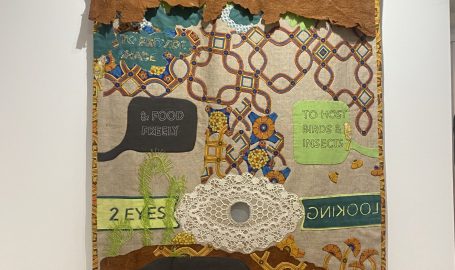
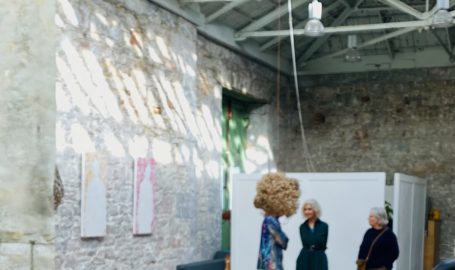
Charlotte Squire presents a banner for the ‘Rights of a Tree’ as part of Flow State at Make SW, referencing trade union banners and William Morris’s writing behind workers rights and craft, where engaging the senses through the handmade process is a key concept.

 Legal standing for the more-than-human inhabitants of natural world was first suggested by academic Christopher Stone in his 1972 paper ‘Should trees have standing?’ asking such questions as; Could nature have rights? Was it possible for a forest to have legal standing?  Who would speak for these natural entities?  

‘Because until the right-less thing receives its rights we cannot see it as anything but a thing for the use of ‘us’- those who are holding rights at the time’  

Elders  of the N American Innu people, the Mi’kmaq, propose the notion of Two-eyed Seeing- the sets of eyes are of indigenous ecological knowledge and western scientific knowledge working together rather than opposing each other.

A banner provides a rallying point for activism supporting rights for nature, whether a forest, a river, and other of Earth’s inhabitants. This ‘Rights of a Tree’ banner is made from textile and bark cloth – a ceremonial cloth used in ritual for births, initiation, marriage and deaths, parallel to those rites of passage taking place in the natural world; insects pupate and birds hatch, fledgelings fledge, plants grow, fungi form and fruit and nuts ripen and sustain. Tree’s shade cools Earth’s human and more than human inhabitants, ever more important in a warming 

Threshold Figure

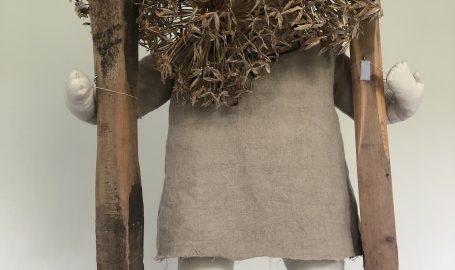
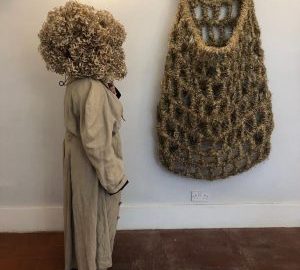
Threshold figure, textile, wood 2025 The Plough Artrs Centre Torrington. Image credit Grace Rogers

Threshold figure was part of Dialogues at the Plough Arts Centre and at Discovering42 as part of FLAMM 2026

Threshold figure shows a cultural disconnectedness from nature in Western societies, using myth and magic realism to recreate connections of coherence and sentience which may have been severed.
Costume, mask and ritual objects for ceremony and performance allow participants a deep immersion into nature’s mysterious workings.

These objects are the only remaining evidence of that performance.

Stiltwalker

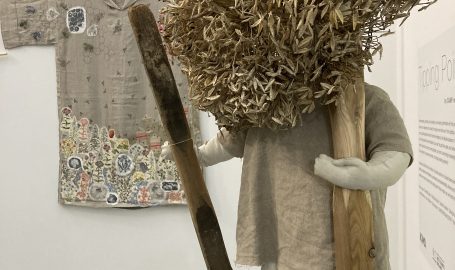
small textile figure on stilts wearing a mask made of agapanthus seed heads

Stiltwalker 2024 textile, wire, wood.

Where Are We Now? at the Thelma Hulbert Gallery Honiton

Stiltwalker is a small figure striding through the landscape. Walking on stilts is something I remember from growing up in Kent, where stilt walkers were used for hop picking & stilts were a natural part of childhood games – here reimagined as a way of navigating a flooded landscape

Where Do We Go From Here?

Eusapia at Sea photo credit Andy Keate for GHosttide, Thameside Studios

‘Where Do We Go From Here’  Workshop2 Ocean Studios Plymouth curated by Charlotte Squire

Eusapia at Sea, used sea water from Devil’s Point to connect with the site at Ocean Studios, RWY, Plymouth –  made originally for GHosttide using Thames water & lifejacket lights

Also showing a new interation of Seedhead as an interactive hanging object that audience can ‘wear”

 artists from Plymouth Kin

Dana Aala, Alan Braidford, Heather Burwell, Caroline Collingridge, Claire Gladstone, Julie Griffiths, Angela Hilton, Jacqui Jones, Monika Rycerz, Ellen Sims, Viv Spencer, Charlotte Squire, Frances Staniforth, Antonia Texidor. 


The Old Gods and the New

‘That all superstition of pagans and heathens should be annihilated is what God wants’ (St Augustine)

The balance of just one item can act as tipping point as I found out when I knocked the piece I was working on off its pedestal and failed to catch it on its way down to smash on the floor.

The head lay in pieces and the idea came to me that the breaking of the work could be part of its resolution 

From as far back as idols and statues have been destroyed by those seeking to promote only one god, the broken statue has been paraded as the proof of its own wrongness, so much consistently part of our culture that as a child I thought that they had been created missing heads, limbs rather than parading of mutilation and reduction of the old gods.

As the world reached and passes a critical point in time when action needs to be taken to slow, halt & hopefully reverse the damage we are doing to our planet, we need to look at belief systems and check how we can revise how we live and what we believe in to achieve change

Review from Miyuki Kasahara for online Japanese magazine Curators Station

https://www.creators-station.jp/column/224775

Crashing the Ecology

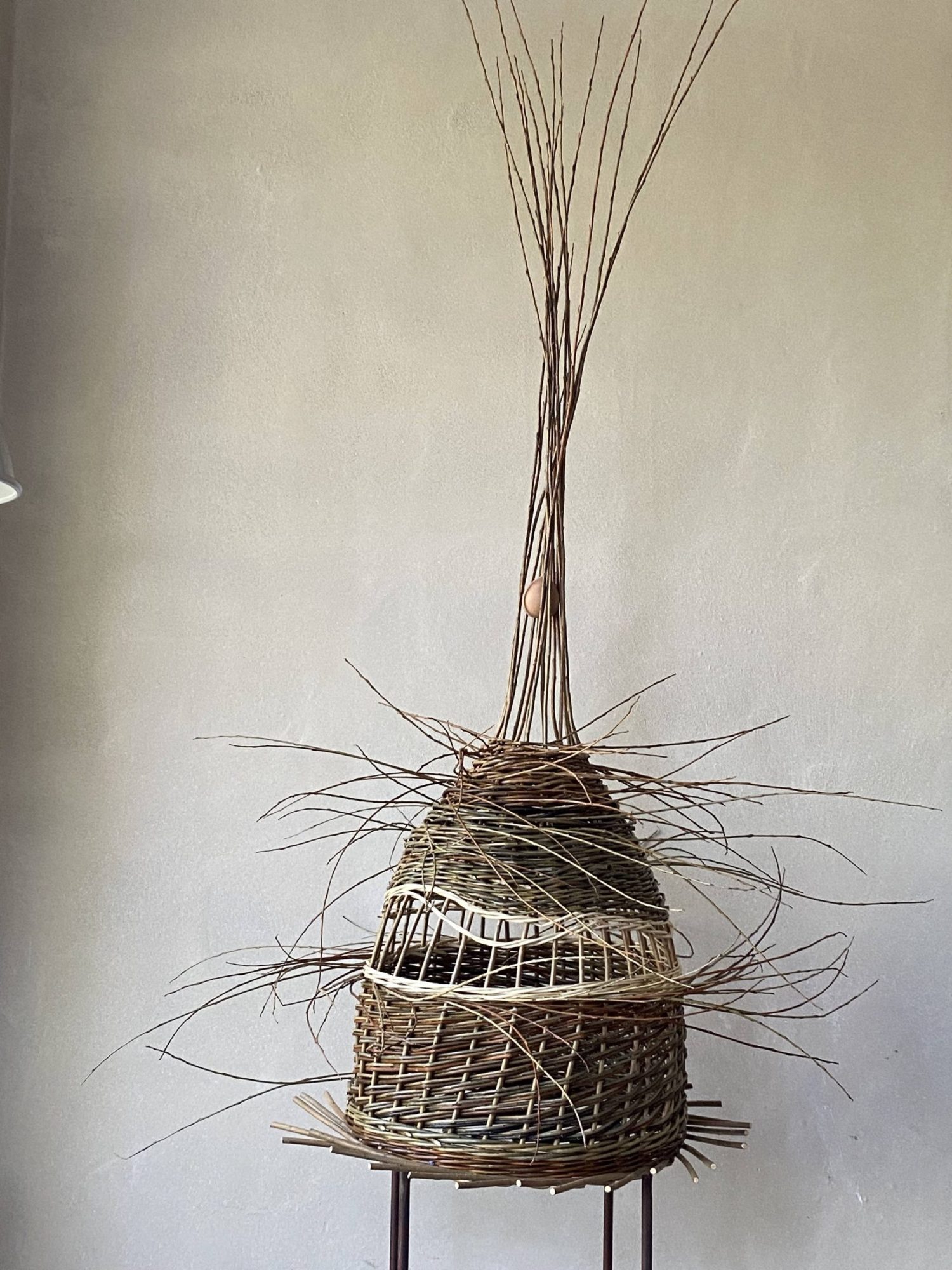
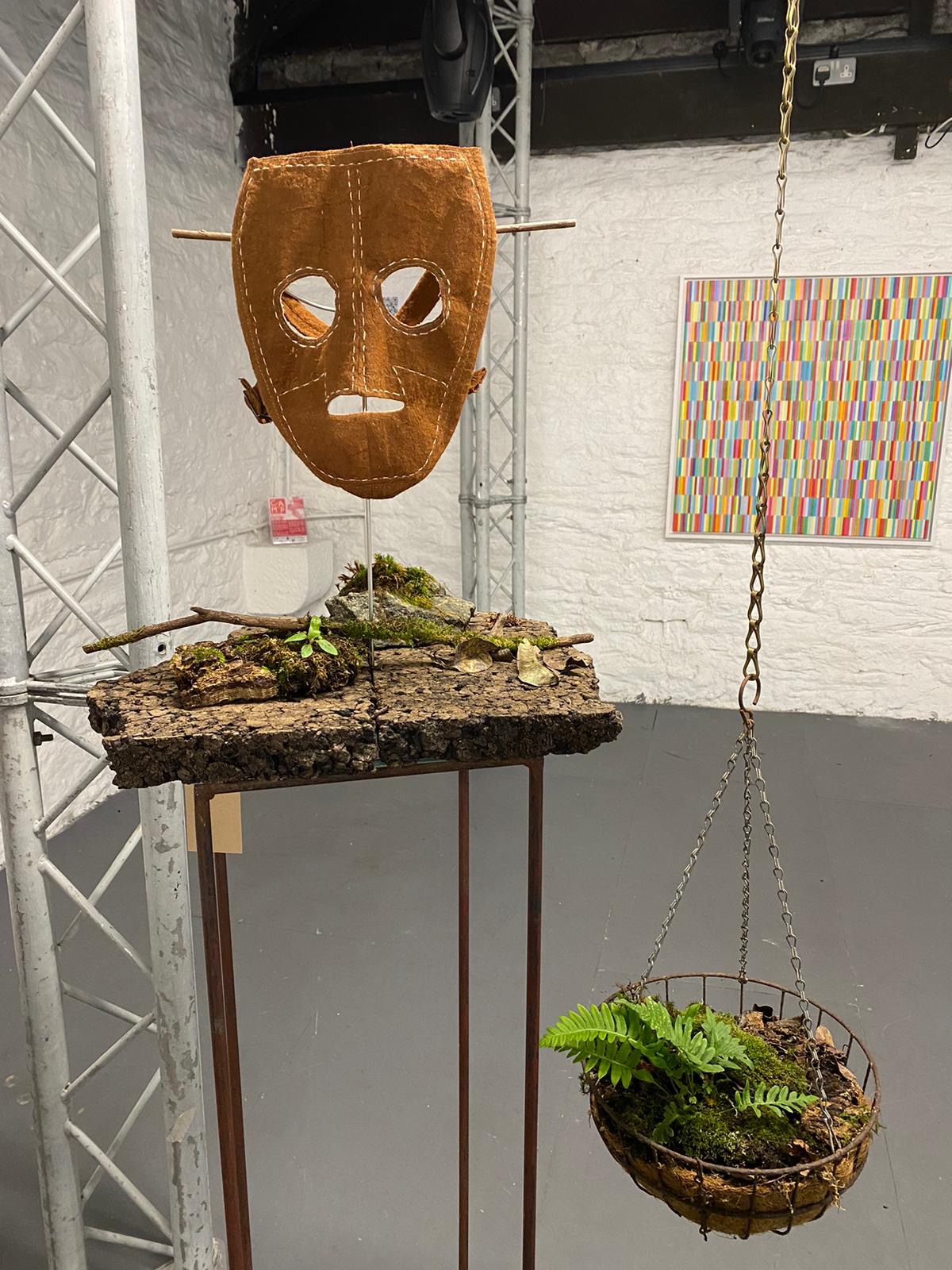
kamikazi mask, hanging basket, moss and ferns

Charlotte Squire’s installations in mixed media/found materials have used myth to explore city habitats and how they adapt to change, whether it be physical, technological, and geographic. Since moving to Plymouth and post covid, her practice has moved towards smaller work, and she has introduced ceramics into her work for the first time.

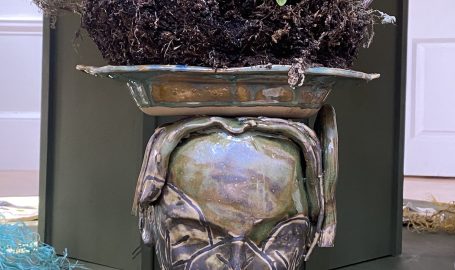
Current work consider how we might live more symbiotically with the natural world given the climate crisis; a small figure on stilts wading through the flooded landscape or a mythical figure growing out of root systems in clay, found objects & textile…


Crashing the Ecology 2023 part of Synergy at Leadworks in Plymouth, curated tina Kutter

Stiltwalker in Tipping Point, Studio Kind

Stiltwalker, 2023 [mixed media] – Tipping Point at Studio Kind, curated Laura Porter

The process of installation is a part of my practice, but focus moves from cityscape as habitat to an exploration of human interconnections with the natural world as concerns of climate change and sustainability gain increasing urgency.

The natural world will still be there after its landscape has been plundered and resources squandered, whether humankind will still be around is another thing…In current work I am thinking about how we might make amends with nature and reinvent our relationship with it. 

Seed Head


photo credits Nicky Hirst 2022

 Spirit figures in mask & costume evoke a magic realism of an older culture needing to be recalled as the natural world struggles with our careless treatment of it….

over lockdown the garden became a sanctuary to grow plants to eat and become reacquainted with the seasonal evolution of plants in my patch. Cv19 year 1 was a wonderful growing year. In year 2, my small patch of crops was decimated by unseasonal plagues of caterpillars and slugs drawing me to think about superstitions, ancient deities and past ritual practice invoked to protect the seasons cycles.

Performing Green curated by Kim Thornton provided an environment to add a performance strand to my practice that I had not previously considered