curated show

Armida’s vexation

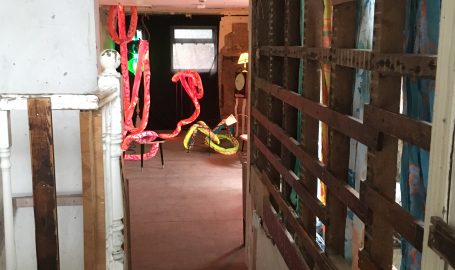
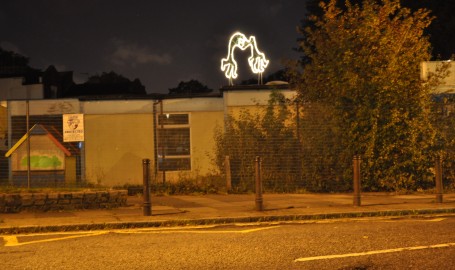
Charlotte Squire creates a sense of wonder and anxiety with her sculptural forms. Her work uses illumination to draw attention to the transformation of mundane materials into something that both engages and unsettles.

This installation was created specially for Dreaming Awake as part of the Dulwich Festival.

Armedia is betrayed by her mortal lover, and uses her powers as a sorceress to keep him prisoner in an enchanted garden.
In Tassos epic poem he is rescued by 2 soldiers but returns to find the distressed Armedia. She loses her power and becomes mortal to stay with him.

Armida’s Vexation part of Dreaming Awake at Safehouse1.

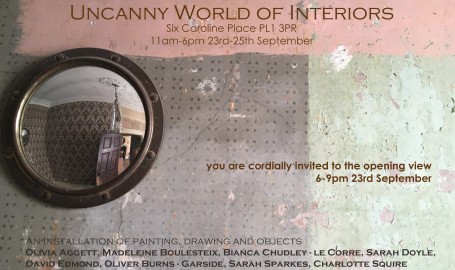
Uncanny World of Interiors

UWoI e-invite5
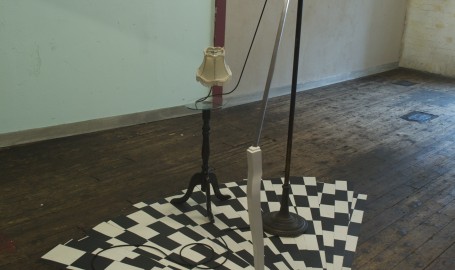
Our interior space for living is where we are most revealed, as here we make our most personal mark. The temporary domestic space at Caroline Place showcases the work of 8 artists and designers working with everyday materials, transforming the mundane into objects of desire.

The unheimlich of Freud’s analysis wherein things pertaining to homeliness and domesticity are somewhat wrong footed by one thing or another, subjective to be sure, make us question what exactly ‘home’ is. A place? A feeling? A tribe we belong to? This is a subject that has substantial contemporary currency as migration and dislocation move cultures from places of conflict or through economic displacement. Small items may be carried from one place to another – or left behind, to be found later and integrated into the scheme of things. Such items and dislocation surface in the disrupted home environment of the Uncanny World of Interiors.

There’s no place like home

e-invite_A5_v_4 1
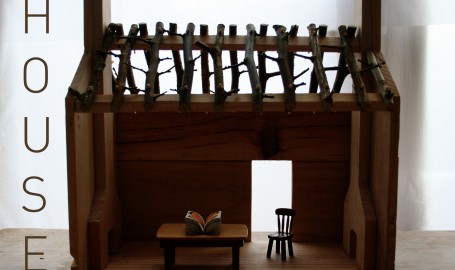
The idea of house and home can conjure up feelings of warmth and shelter. A dwelling – be it cottage or shed, tent or mansion, temporary shack or permanent residence – is usually the basis of comfort and security. Conversely, a derelict or abandoned house is often associated with discomfort, unease and absence.

This exhibition brings together six artists who use the domestic space and objects as a springboard for their ideas. Showing sculpture, installation, prints, drawings, painting and textiles, they explore the idea of ‘house’ in many and various guises. From Amy Sterly’s ‘speaking’ house prints to miniature staircases, meticulously carved from soap by Felicity Warbrick; from Jeanette Orrell’s exquisitely drawn brushes and wire whisks to Charlotte Squire’s exuberant lampshade installation; from Ainsley Hillard’s subtle suggestions of memory to Frances Carlile’s sculpture and prints, where house merges with landscape. Together they present House, an exhibition which explores the many meanings of home.

To accompany the show, we are featuring an artist a week on social media with an exclusive Q&A about the work in their show.

http://www.orieldavies.org/en/exhibition/house

4409.72 miles 9125 days

4409.72 miles 9125 days
Opens 21.11.14 then on ’til 31.01.15

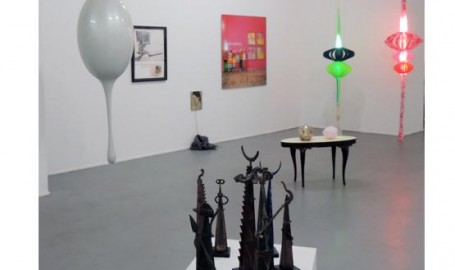
This year Diana Lowenstein gallery is celebrating its 25th anniversary.  Ombretta Agró Andruff has curated a retrospective for this milestone:

25 Years of Art Discourse from Buenos Aires to Miami

It is a great honor to have been asked by Diana to curate the exhibition celebrating her gallery’s 25 years of activity. I had never worked on a ‘retrospective’ type of show before and I truly enjoyed the challenges that this new approach presented.


The project took seven months in the making, much of them spent researching the gallery’s rich archives of documents, amongst them the catalogues that accompanied each exhibition from 1989 to 2000, and several conversations with Diana and her longtime office manager Juliana, who were both an invaluable source of information.


The more I familiarized myself with Diana’s passionate connection to ‘her’ artists and her ‘glocal’ approach when it comes to her program, the more I felt the need for the show to progress on two parallel tracks: one was to study and reinterpret the gallery’s 25 year history, the other to underline its current activity and future plans. Hence, the decision to dedicate a special place to the four Miami-based artists currently represented – Felice Grodin, Michael Loveland, Chu Teppa and Alex Trimino – who are each presenting solo projects especially conceived for this occasion and displayed in four shipping containers positioned at the gallery’s exterior.


The rest of the show includes more than fifty international artists, from masters as such Francis Bacon, Wifredo Lam and Antoni Tapies, to the young and up-and-coming, whose work is exhibited inside the galleries. The artworks are arranged in eight groups that began to take shape as the research developed: Color; History; Human Body/Portraits; Materia y Forma; Patterns; Symbolism; Text; and Vacío. No specific chronological order was followed in devising the salon-style exhibition design allowing the groups to form solely based on formal or conceptual commonalities that emerged amongst the pool of artworks that make up the extensive inventory.


Fascinating and unexpected dialogues arose as the works violently collided into each other or politely engaged in subtle conversations. In Portraits, a gorgeous Bacon lithograph inspired by Ingres found its place between the lascivious bronze sculpture of a naked woman by sculptor Jim Amaral (United States/Colombia) and the street-art inspired painted stadium seats by artist Carlos de Villasante (Mexico/United States).


In Vacío, a section presenting works that share a minimal aesthetic and/or are devoid of colors or human presence, a gem by master Eduardo Chillida (Spain), a tiny etching on paper, is hung next to the delicate perforated work on paper by Gye Hoon Park (Korea) and the mesmerizing photograph of a dilapidated baroque interior of an abandoned building by Fabiano Parisi (Italy), all sitting across from a contemplative floor sculpture made of glass and water by Udo Nöger (Germany/United States).


The gallery’s corner dedicated to Color is taken over by a pink circular wall work by Xawery Wolski (Poland/Mexico) made of semi-precious stones embedded in a clear acrylic support hanging side-by-side with a bright, sequins-embroidered canvas from the seminal ‘skull series’ by Daniel Gonzalez (Argentina/Germany/United States), both facing a colorful installation of small biomorphic sculptures arranged on a 1950s coffee table by Clemencia Labin (Venezuela/Germany).


And lastly, Michael Scoggins’ (United States) colorful map engages in a conversation with a black & white etching on paper with embossed text by renowned Catalan artist Antoni Tapies (Spain) as well as with a selection of small assemblages on paper by another art star of a younger generation, Jaume Plensa (Spain), in the section dedicated to text-based works.


The list could go on forever as the possibilities for exchanges amongst the works presented are indeed endless. Despite its structure, in fact, the show aims to present a fluid discourse in the form of a diary documenting the past 25 years of a love story between Diana and ‘her’ artists. No barriers or signage separate the various sections. It is my hope that viewers will let their eyes wander and their synapses run wild and connect as many dots as possible allowing for their own stories to emerge.


The groups and the artists:


Color:                                        History:                     Human Body/Portraits:  

Sagastizabal Paez Bacon
Gonzalez Torres Llorca Adami
Clary Sacco Amaral
Jimenez Fors Colectivo MR
Labin Gallardo de Villasanta
Wolski Garcia
Lindner Pena


Materia y Forma:              Symbolism:                            Patterns:


Dompe Matta Cecchini
Bairon Lam Machado
Villanueva Bedia Ortiz
Christo Miro’ Lamiel
Squire Peters Brown
Lathan Kina Hart
Padilla
Paredes


Text:                                           Vacío:


Scoggins Rivas
Miranda Chillida
Torres Llorca Noger
Tapies Parisi
Plensa Park Gye Hoon
Glajcar

Ombretta Agró Andruff, curator

The Curtain Dog

curtain dog view lr

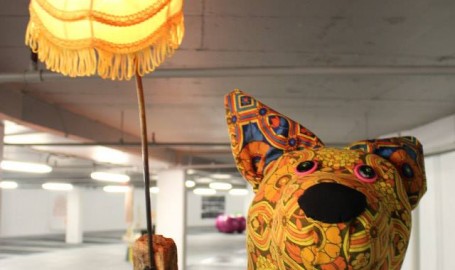
Tales of the uncanny and personal reference, a self portrait of the artist as a toy – curator Sarah Sparkes’ brief; ‘The Hollow’ formed a segment section of We Could Not Agree, an independent art event at underground venue Q-Park hosted by Geoff Leong, Cedric Christie and Vanya Balogh.

The Curtain Dog stomps past surreptitiously on his makeshift stilts lighting the path with a small bedroom light. Bringing to mind a displaced Diogenes carrying a hopeful small lampshade lantern through the complex sophistication of the art world, his oversized stuffed head and large button eyes purposefully sniffing out a safe passage through the circularity of the subteranean parking space under London’s shopping streets, hotels, restaurants and the seasonal Frieze art fair.
The original curtain dog was fashioned from left over kitchen curtain fabric in the sixties. Making was an integral part of entertainment our growing up world. My dad made us toys; rocking horses, toy chests, puppets, and I, my sister and three brothers made theatres, props, disguises and characters and toys for each other. I made the first curtain dog for my youngest brother who absorbed him into his circle of play friends.

The stilts are part of another story, as this is a portrait of the artist as a full sized toy, they are used to bring the childish character to adult lifesize.

The Dream Machine

Transition Gallery Unit 25a Regent Studios, 8 Andrews Road, London E8 4QN


Sluice Art Fair – October 2013


The Dream Machine

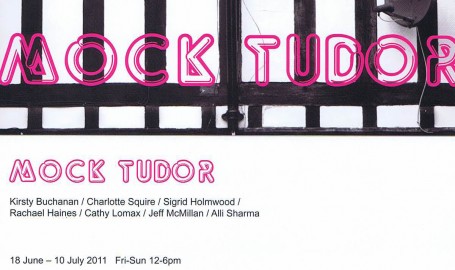
 Kirsty Buchanan, Sarah Cleaver, Sarah Doyle, Paul Kindersley, Cathy Lomax, Alex Michon, Travis Riley, Alli Sharma, Corinna Spencer, Charlotte Squire, Mimei Thompson


‘Even though life isn’t black and white it often looks better that way.’

Barry Gifford


 Behind every starry silver screen performance there is a real person who has been sucked into the machinery, restyled and re-presented in a recreated environment as the hero or villain of our dreams. Since the early 20th century Hollywood has transformed these mere mortals into gods, stripping them of their skeleton-laden identities and grinding them out as perfect, plastic covered, star shaped deities. This machine of dreams is of course a charade, and the cinema is a place where nothing is as it seems, a place where the real is always mingled with the imagined.

The Dream Machine is a group show of nine artists who inspired by the black and white magic of early cinema, juxtapose the glamorous imagery, PR driven myths and dreamlike stage sets with the downbeat behind-the-scenes construction and all-too-frequent real life tragedy that is the reality of Hollywood’s dream machine. Because as Joan Crawford said ‘You manufacture toys, you can’t manufacture stars.’