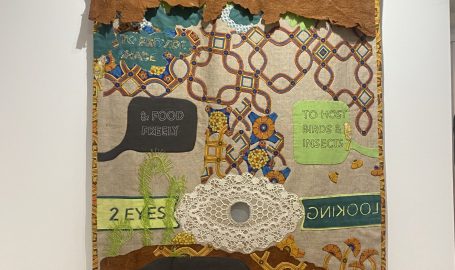
banner

Rights of a Tree


Charlotte Squire presents a banner for the ‘Rights of a Tree’ as part of Flow State at Make SW, referencing trade union banners and William Morris’s writing behind workers rights and craft, where engaging the senses through the handmade process is a key concept.

 Legal standing for the more-than-human inhabitants of natural world was first suggested by academic Christopher Stone in his 1972 paper ‘Should trees have standing?’ asking such questions as; Could nature have rights? Was it possible for a forest to have legal standing?  Who would speak for these natural entities?  

‘Because until the right-less thing receives its rights we cannot see it as anything but a thing for the use of ‘us’- those who are holding rights at the time’  

Elders  of the N American Innu people, the Mi’kmaq, propose the notion of Two-eyed Seeing- the sets of eyes are of indigenous ecological knowledge and western scientific knowledge working together rather than opposing each other.

A banner provides a rallying point for activism supporting rights for nature, whether a forest, a river, and other of Earth’s inhabitants. This ‘Rights of a Tree’ banner is made from textile and bark cloth – a ceremonial cloth used in ritual for births, initiation, marriage and deaths, parallel to those rites of passage taking place in the natural world; insects pupate and birds hatch, fledgelings fledge, plants grow, fungi form and fruit and nuts ripen and sustain. Tree’s shade cools Earth’s human and more than human inhabitants, ever more important in a warming